Now Reading: Is Tipping Still an Expression of Satisfaction — Or Just a Tax We Accepted?
-
01
Is Tipping Still an Expression of Satisfaction — Or Just a Tax We Accepted?
Is Tipping Still an Expression of Satisfaction — Or Just a Tax We Accepted?

Somewhere Between Gratitude and Guilt, Tipping Stopped Being a Choice. And Nobody Asked If That Was Okay.
By Paginter Editorial • Society & Culture
There is a quiet shift happening in restaurants, cafés, and service counters everywhere, and most people feel it without being able to name it. The tip, once a spontaneous gesture of satisfaction, has been slowly and steadily repositioned as a non-negotiable line item. Not by law. Not by any open agreement. By social pressure so normalized it now comes pre-loaded on a screen, suggested at 30%, 35%, or 40% before you’ve even decided if the experience was worth it.
And that is worth stopping to question.
What a Tip Was always Meant to Be
By definition, by its very nature, a tip is an expression of satisfaction. It is the customer’s way of saying: you went beyond what was expected, and I want to acknowledge that. It was never designed as a wage. It was never a contract. It was a signal: voluntary, personal, and meaningful precisely because it wasn’t required.
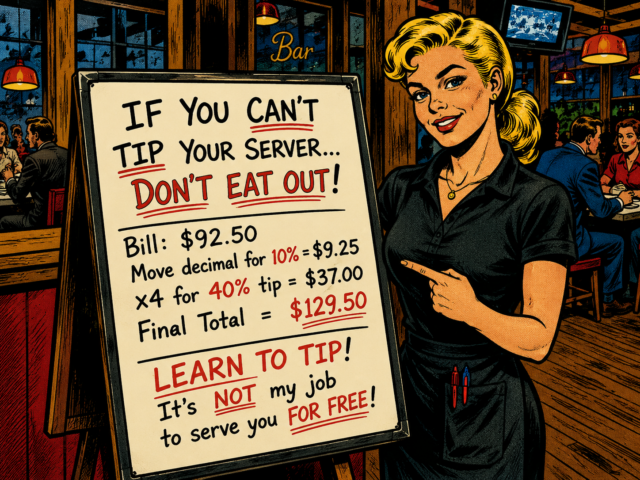
That meaning doesn’t disappear by accident. It disappears when the gesture is replaced by a mandate. When the whiteboard tells you the correct tip is 40%. When the tablet rotates toward you with no zero option visible. When a sign at the entrance of a restaurant warns you not to eat there if you can’t tip your server. At that point, you are no longer being invited to express appreciation. You are being told to pay an additional fee that someone else has decided you owe.
Those are two completely different things, and confusing them is how we got here.
The Obligation That Wasn’t
What’s striking about the current tipping conversation is how completely the original premise has been abandoned. The question used to be: was the service good enough to deserve recognition? Now the question has become: how much are you obligated to add, regardless of the experience?
Consider what several voices in this debate have rightly pointed out: service is what should drive the tip, not the size of the bill. A large bill doesn’t guarantee attentive service. A 40% suggestion on a $92.50 tab doesn’t reflect anything about the actual interaction. It’s a calculation built on the assumption that the customer owes a percentage of consumption, which is, in every meaningful sense, a tax. Just an informal one, enforced by guilt rather than law.
One perspective worth sitting with: “Do a bad job, lose your tip. It’s simple.” That isn’t harsh. That is the original logic of tipping, stated plainly. The tip was always meant to be earned, and the freedom to withhold it was precisely what gave it value. A tip that cannot be withheld is not a tip. It’s a surcharge.
The Worker Caught in the Middle
None of this means the frustration of service workers is invalid. In fact, the opposite is true, and this is the part of the conversation that gets lost when it devolves into shaming customers.
In the United States, many tipped workers earn a legal base wage as low as $2.13 per hour. The tip, in that context, isn’t a bonus. It’s survival. And that is a genuine injustice, but it is an injustice created by employers and legislators, not by diners. The restaurant owner who pays poverty wages while charging market prices for food has offloaded the moral weight of fair compensation onto the customer’s conscience. And it works, because most people don’t want to feel responsible for someone else’s hardship.
But here is the important distinction: understanding that system doesn’t mean accepting it as the customer’s problem to solve. Empathy for a worker doesn’t require surrendering the right to evaluate service freely. The two can and must coexist.
As one clear-eyed observer noted: “If they make an hourly wage, they are doing what they get paid to do. A tip is to show appreciation for over and above service.” That’s not a refusal to care. That’s a defense of what tipping was supposed to mean, and a quiet argument that the broken wage model needs to be fixed at the source, not patched over at the point of sale.
When Pressure Replaces Appreciation
Here is the deeper problem with turning tips into obligations: it doesn’t just change the economics. It changes the entire human dynamic of the transaction.
When a customer tips freely, because the service moved them, because someone was kind or fast or genuinely attentive, that gesture carries weight. It communicates something real. When a customer tips because a screen prompted them, because a sign shamed them, because social pressure made refusal feel like a character flaw, that gesture communicates nothing. It’s compliance, not appreciation. And no amount of compliance has ever made anyone feel genuinely valued.
The drive to mandate tipping doesn’t protect the spirit of tipping. It hollows it out entirely.
The Line Worth Drawing
People and businesses have quietly forgotten something fundamental: the tip belongs to the customer. Not in a selfish sense, but in the sense that it was always theirs to give, freely, based on their own experience of the service they received. The moment that freedom is pressured out of existence, the tip stops being what it was.
You can believe servers deserve fair pay and still believe that 40% demanded upfront is not a tip. You can respect the hard work of service and still believe that an unsatisfied customer owes nothing beyond the price on the menu. You can care about people in the industry and still refuse to participate in a system that has quietly reframed your generosity as your debt.
So, is tipping still an expression of satisfaction, or just a tax we accepted? The honest answer is that it’s becoming the second, one guilt-laden payment screen at a time. The tip is not mandatory. It never was. And the fact that so many people have forgotten that, or been made to forget it, is exactly the kind of shift worth naming out loud.
Fenton Parker
PAGINTER • Insight & Discovery Media