
Now Reading: Codex vs. ChatGPT: Do We Need to Switch, or Are We Missing the Point?
-
01
Codex vs. ChatGPT: Do We Need to Switch, or Are We Missing the Point?
Codex vs. ChatGPT: Do We Need to Switch, or Are We Missing the Point?

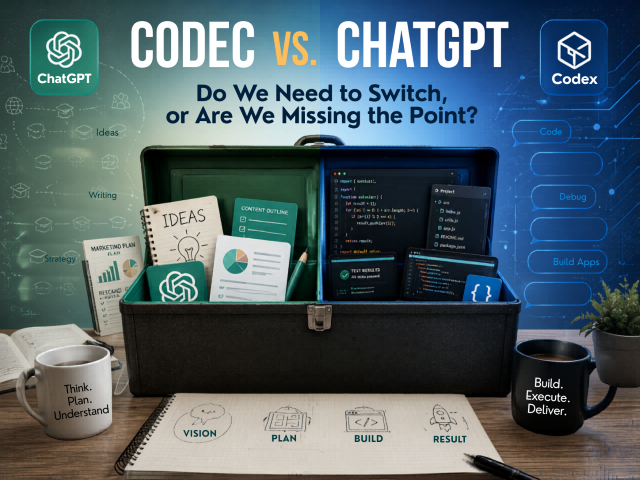
By Fenton Parker • Technology & Society
When OpenAI released Codex, something predictable happened: ads began appearing online suggesting that users should switch to it. And with those ads came the questions.
Is Codex going to replace ChatGPT? Do we need to switch? Should we be using both?
We found ourselves asking the same thing. And we figured that if we were wondering, others probably were too. So we looked into it, and the answer turned out to be much simpler than the marketing suggests: no, Codex is not replacing ChatGPT. They were built to do two different jobs.
Why the Confusion Happens
Part of it comes down to marketing. Many of these ads are aimed at developers and technical teams. Their message isn’t “stop using ChatGPT.” It’s “there’s now a specialized tool for coding tasks.” But once that message reaches a general audience, it gets reinterpreted as a verdict on ChatGPT itself: is it being phased out?
It isn’t. And this pattern is worth noticing, because it isn’t unique to Codex. Every time a major AI company releases a new specialized tool, the same cycle repeats: a product built for one group gets marketed in a way that makes everyone else wonder if their current tool just became obsolete. Codex is simply the latest version of a question people have been asking for years, under different names.
What Each One Actually Does
ChatGPT is a general-purpose assistant. It’s the tool for research, writing, brainstorming, business planning, and working through ideas. It functions like a consultant, teacher, or editor, helping you think, plan, and produce.
Codex is built specifically for software. It writes and edits code, analyzes projects, fixes bugs, and runs tests. It behaves less like an advisor and more like a specialized engineer focused on execution.
Worth noting: Codex comes from the same company and can even be accessed through ChatGPT itself. These aren’t two competing platforms asking for your loyalty. They’re two functions of the same expanding toolkit.
The Question That Actually Matters
The useful question isn’t “which one should I choose?” It’s “what am I trying to accomplish?”
Planning a house is a good way to think about it. An architect defines the vision, the layout, the design. A builder turns that vision into something real. Neither replaces the other, and you wouldn’t ask a builder to redesign your floor plan or an architect to lay bricks.
ChatGPT is the architect: it helps you think and plan, whether that’s an article, a business strategy, or a presentation. Codex is the builder: it helps you implement, whether that’s an application, a bug fix, or a piece of software. One gives direction, the other gives execution, and used together, they cover far more ground than either does alone.
So, Do We Need to Switch?
No. Most people don’t need to abandon ChatGPT, and they don’t need to pick a side. The two tools exist for different purposes, and the real skill isn’t choosing between them. It’s recognizing which one fits the task in front of you.
This is also a useful lesson for what’s coming next. As AI continues to specialize, more tools like Codex will appear, each one built for a narrower job: design, data analysis, research, creative work. Each launch will likely trigger the same wave of “should I switch?” questions. The answer will almost always be the same. The toolbox is getting bigger. The skill worth building isn’t picking a side. It’s knowing which tool belongs in your hand for the job you’re actually doing.
Fenton Parker
PAGINTER • Insight & Discovery Media